The Most Important Career – an Email to a Friend

I wrote this in an email to an author friend, on the subject of writing as a career, as opposed to other, more lucrative and “parent-and-society-approved” professions.  I’m posting it here in the hopes that it resonates with other writers as well:

Frankly, I think writing fiction is the most important, most noblest career anyone can aspire to.  That may just be my years of wanting it so badly brainwashing me into thinking that, but stories are important.  They change lives, they comfort us when we’re sad (no one understands you like your favorite book, you know?), they let us glom up all the experiences of another person, both the fictional experiences of the characters and the real thoughts and emotions and tidbits of reality put in by the author.  Stories are transformative and allow us to experience change in a safe setting.

And writing is hard.  You could take a writing class, turn in all your assignments, and get an A but still be a crappy writer.  It’s learnable, obviously, but it takes a lot of time and effort.  People often say it’s a ten year apprenticeship, which it definitely was for me, though I guess it depends on how quickly you get in your million words/10,000 outlier hours.  But that’s a lot, and that’s just to be publishable, just to start a writing career.  And most people don’t have the discipline to put in the crazy time and effort it takes to become a pro writer.  Everyone who’s read your books has a little piece of you in their minds now.  That’s pretty amazing.  More amazing, I think, than going to grad school or earning lots of money.

Gamification, Behaviorism, and My Cat

This week in my Meaningful Gamification class, we’re studying behaviorism and how rewards are used to affect behavior.  So basically people have studied how doling out rewards/in what ways they’re doled out affects learning.  So if you have someone push a button to get a reward, but they only get a reward at one minute intervals, then they learn not to bother pushing the button until that one minute mark.  But if you make the rewards come at random times, so that the person never knows when pushing the button will get them something, then they learn that behavior really well and it becomes an addictive “checking” habit.

When I was listening to that part of the lecture, my first thought was, “Wow, that sounds annoying.  What a stupid thing to get hooked on.”  And then of course I realized that it sounds EXACTLY like me checking my email.  I think most of us can relate.  And if you’ve ever gotten a really good email–whatever that might be to you–that gives you a really good spike in happy chemicals, then it becomes even harder to quit.  Mostly, though, it doesn’t matter if I ever get the reward of an email or not–checking for it has become an addiction and just the hope of having a message keeps me going.  If I leave for a few days and don’t check my email, then I break that habit a little and I don’t feel the need to check once I get home.  I always feel at that point like I could just walk away from it.  But then I get curious and want to check, just once, just to see… and it’s a slippery slope from there.  (I read once in an entrepreneurial magazine that it’s recommended you check your email no more than four times a day, so it doesn’t become stressful.  I think I’ll start by cutting back to four times an hour.)

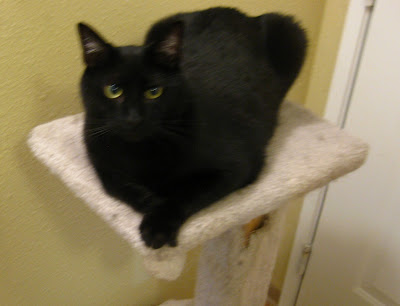
And it’s not just me and the other email/Facebook/Twitter addicts out there, by my cat, too.  One of my cats, Kitten, saw a particularly
interesting skittery bug in the corner of the bathroom once, maybe twice, and now he’s hooked.  No matter how many times he doesn’t see a bug in the corner, he can’t stop checking for it.  And every time he checks, even if he comes up empty, it seems to reinforce the behavior, making him just want to do it more.  Every time he follows me into the bathroom (he’s also obsessed with following me around everywhere, so maybe he’s prone to addictive behavior–I don’t know), he goes right to that corner and checks it out.  Sometimes he’s in there just staring into the corner, hoping and waiting.  And I often think, “Wow, that is sad!”  And then I wonder if it’s really any sadder than checking the internets over and over.  I mean, I’m pretty sure all my precious emails are a little more important than the possibility of there being a bug in the corner.  But as much as I don’t care about chasing bugs, I’m sure Kitten is equally unimpressed by chasing emails.  If getting to see a bug gives him the same spike of happiness, then is it really any different?

My First Knitting Pattern!

As most of you probably know (I think), I do a lot of knitting and crocheting.  Last year I made my first venture into crochet design with the ponies, and this summer I made my first knit design.  In all my years of knitting and crocheting, I honestly thought I would never get into design work, but I really love it.  It’s kind of like with writing where I read tons as a kid and so of course I wanted to make my own stories.  And now I knit and crochet tons of stuff, too, and eventually there’s that drive to create something.

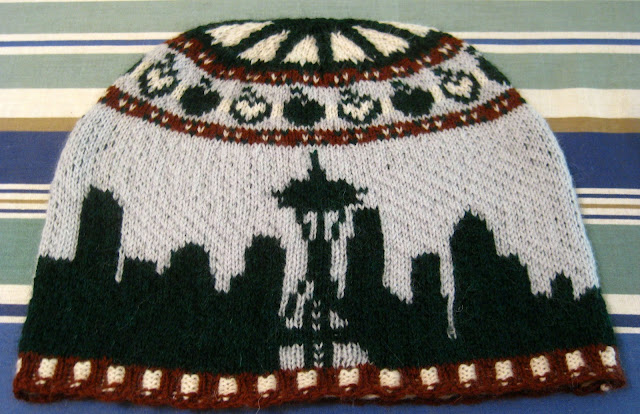
I was inspired to make this when I saw a hat with the NYC skyline on it.  It’s supposed to be one of the most recognizable skylines in the world, and I thought, “Maybe, but the Seattle skyline is MORE recognizable.”  (Though I admit I may be a bit biased…)  So I sat down with a piece of graph paper and a Google image search on the Seattle skyline and got to work.

Rainy Day Seattle Hat:

Reminiscent of a cool, rainy morning in the Northwest, this beanie-style hat has everything you need to show off your love for the Emerald City. The hazelnut and cream ribbing represents warming up with a hot mocha on a cold day, while the Seattle skyline rises against a typical drizzly gray backdrop. (The dark green yarn carried in the back shows through the gray a little, creating the perfect rainy look.) Washington apples form a ring above the city, alternating between solid green and heart-shaped outlines, and snow-covered evergreens top off the ensemble.

You can see more pics (or buy the pattern) on Ravelry.  Also, if you have a Ravelry account, feel free to friend me!

I Exist Again!

As of now I just finished my last final for summer semester!  Now I have two weeks off before it all starts up again…

Book wise, I have not forgotten about you all who are diligently waiting for The Trials of Renegade X.  I’ve had to put it on hold for a bit while I work on finishing up my dark YA fantasy, Fire and Chasm, which needs to go back out on sub.  And I’ve been working with the amazing Karen Kincy (author of Other, Bloodborn, and the upcoming Foxfire) on the Steampunk Book of Awesome.  Two books at once is about all I can handle, but as soon as I finish up Fire and Chasm, I’ll be back to working on the Renegade X sequel.

Knitting wise, I am working on my first original pattern (I’ve only made crochet patterns), and am also dying to make this Louhi coat.  It’s the long gray one that looks really archaic and cool.  I’m finishing up a cape right now and this hoodie (as soon as I actually buy the rest of the yarn I need), but man do I want to cast on and start that Louhi coat!  It turns out I like making capes and coats and cloaks and things.  And hoods.  I can’t own enough coats and it turns out I can’t make enough of them either.

Life Changer – Writing sans Internet

Once upon a time, in 2004, in a faraway land called Bellingham, WA, where the sky, the earth, and the sea are all the same shade of gray, I got it into my head that I wanted a portable writing device.  I had a desktop at the time and I wanted to be able to write anywhere, whether that meant when I was out of the apartment or just when I was sitting on the couch.  I did a lot of research and discovered the NEC Mobile Pro.  (Which, as you can see if you follow the link, is also gray.)  It was super portable, had an actual keyboard (not full size, but it worked), and it turned on and off instantly, which meant no waiting for my computer to boot up in order to write down any brilliant plot ideas I had at one in the morning.

I got a refurbished one off of eBay.  It had a spot where you could plug in your dial up internet (LOL), and the one I got came with a WiFi card so you could connect to the network, even if it was kind of slow.  But I never ended up using the internet on it.  It was a little tiny box with Pocket Word and a word count meter and almost nothing else.  There were no distractions, and it changed my life.

Or at least my writing life, which was pretty much the same thing.  Not only was it light and portable and I could sit wherever I wanted with it or write in the quiet room at the university library, but I became way more productive.  And it’s not that I’d never experienced periods of high productivity with my writing, even with the internet, but it was so much easier to get into that mode without having the option of turning to distractions every time I got stuck.

In the summer of 2007, the same summer I finally graduated college and the same summer that the last Harry Potter book came out, I wrote The Rise of Renegade X, all on that little computer.  Then, two years later after I’d sold the book and gotten paid for it, I bought a shiny new laptop.  I love my shiny not-so-new-anymore laptop that literally sparkles in the sunlight (there are blue sparkles on the lid, but they only show up in direct sunlight), and at the time I’d badly needed a computer that actually functioned, since my desktop was, on its good days, barely still functioning.

So I got the laptop, and it did all the computery things I wanted it to do, like play games and play videos (with sound! and without blue screening at random times!) and check my email 1,000 times a day.  And gradually I stopped using my MobilePro.  My laptop didn’t have a spot for the sync cable, my MobilePro had no USB ports, and my laptop couldn’t read the card that the MobilePro could actually save to, at least not without hooking up a separate card reader, and the card itself was unreliable and would frequently forget everything that I’d saved on it.

Anyway, since then I’ve been writing exclusively on my laptop, which has about a million distractions on it, including the internet, which I can’t stay away from.  And if it’s not the internet, then it’s Spider Solitaire.  And lately I’ve been especially prone to these distractions and I have a lot of writing projects I’m not making enough progress on, if any.  So I decided it was time to go back to an internet-less computer.

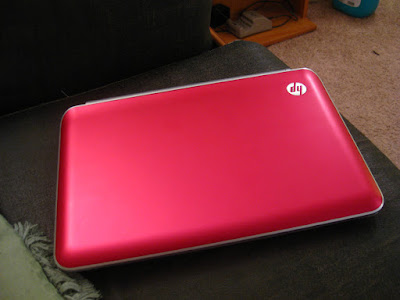
I did tons of research and got this slightly used HP Mini for a great deal on eBay:


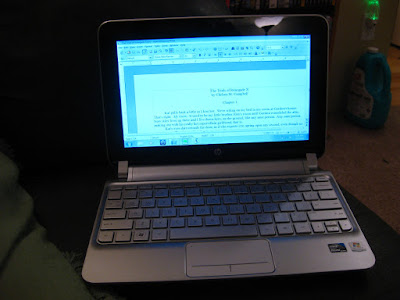
This netbook ended up being the perfect combo of everything I wanted.  USB ports, card reader, runs actual Windows (instead of CE) so it can handle Open Office and doesn’t screw up formatting when I’m passing files between computers.  It’s lightweight and gets almost 10 hours off one battery charge and it comes out of hibernating instantly, and the boot up time when I turn it on is super fast, too.  And the keyboard, which you can see in this next picture, is just how I wanted it.  Chicklet style with a hard base.

(As you can see in this pic, I am clearly working hard on The Trials of Renegade X.)

I uninstalled any unnecessary programs, deleted all the games, and left the whole thing not connected to the network.  It has my writing programs and that’s pretty much it.  It’s amazing how big a difference not having those distractions makes!  Instead of being unfocused and looking for ways to procrastinate, I’m actually, you know, working.

Sometimes it pays to know what works best for you.  If the internet is there, I will poke at it.  I won’t be able to leave it alone, and I know this about myself.  And it can make working on my laptop a source of stress.  In contrast, the netbook feels like a quiet, stress-free workspace that is just me and my books and the tools to make them better.


I’m Only Happy When It Rains – A NW Girl’s Ballad

So you know that Garbage song, I’m Only Happy When It Rains?  Yeah, well, it took me forever to realize that song was about being emo.  Not like I’m actually only happy when it rains, but when you grow up in the NW, especially in some sort of black hole rain shadow, a rainy day is so comforting.  I got on this subject because yesterday it rained, and it was cold and chilly and wet and we had the windows open so all of that could blow in.  A good rainy day, where you can hear the rain outside and smell it in the air, always makes me feel safe and like everything is right with the world.  It’s the kind of thing that makes you say, in all seriousness, “Wow, it’s a beautiful day today,” when you get up in the morning and everything is wet and cold and nostalgic.

And it’s not like I like being wet and cold or anything.  It’s funny how this kind of weather reminds me of walking to school back in junior high, and while I don’t remember particularly enjoying that part of my day–especially if it involved cold drops of water pouring over me–but the same weather now can make me think of those times and only pull out the good stuff, like the way the rain makes me feel so alive.

I have a vitamin D deficiency, and some days, despite taking supplements, I sit here longing for the sun like nobody’s business.  I feel like some withering old plant dying in the corner.  And sometimes I think maybe one of these days I’m going to have to relocate to a place with actual sunlight.  And then a rainy day comes along and I’m pretty sure I couldn’t ever leave here.

Wondering Where I’m at with the Renegade X Sequel?

So, I can admit that the beginning of the year was a lot busier than I expected (A LOT busier).  I pubbed my middle grade noir mystery, Harper Madigan: Junior High Private Eye.  I expanded from doing commissions on DeviantArt to an actual Etsy business.  I was taking grad school classes.  I spent my spring break working a (stressful) temp job.  And I finished up another temp job earlier this month.

If I never work another 9-5 job, I will not be shedding any tears.  I am seriously not cut out for it.  Probably most of us aren’t.  I keep reading about how more and more of us are turning to freelance work, so I know it’s not just me.

But anyway!  Some of you have been asking about The Trials of Renegade X and how it’s coming along.  And now that my workload has mellowed out and the nervous breakdown meter is no longer on orange alert, I’ve finally been able to sit down with this book again and make some progress.  (For those of you not reading this directly from my site, the word count bar is up to 5,700, about 8% of the expected total.)

And this isn’t really a surprise, but I LOVE this story.  Even though I’ve had it planned out for months, it’s hard to get back into writing when I haven’t done it in a while, and especially when I haven’t been writing regularly.  But the more time I spend working on this, the more I love it and the more into it I am.  I’ve crossed the threshold of “Juggling all this stuff is hard! *WHINE*” to “OMG, I can’t wait to put in this and this and this, and THIS cool thing goes here, and wait, there was a better way to phrase that sentence I wrote five pages ago…”  It’s like the difference between pushing a piano upstairs and sliding down the banister.  (Not that I can slide down banisters.  But, you know, if I *could,* then I’m sure that’s what it would be like.  For the record, I’m pretty sure I can’t push a piano upstairs either.  In fact, I’m more likely to pull off a really awesome banister slide than I am to move a piano at all.)

And The Trials of Renegade X now has a Facebook page.  It’s where I’m posting my daily word count.  Go there, press like, and you can watch the book grow (and shrink and then grow again, as books are wont to do…) and show your support and tell your friends and all that.  I mean, you do have friends, don’t you?  And you wouldn’t want to be accused of depriving them of something awesome, right?  RIGHT? *makes squinty accusing eyes*

Ahem.

Anyway, you might be wondering when this book will be done, and, more importantly, when can you have it???  Well, according to my estimations–*types random numbers in giant calculator with one of those paper rolls coming out the back*–I should be done with the first draft in 2 – 3 months.  But you never know when I might get crazy obsessed and not be able to stop myself from doing anything besides writing.  But you also never know when life will get completely overwhelming and get in the way.  So, yeah, 2 – 3 months.  Then there’s editing and revising to do.  And then–THEN–you can have it.  And by my calculations, that means it will be out some time this fall, late November at the latest.  Which means it’ll be out in time for the holidays and you can surprise all your friends you “forgot” to link to the FB page with copies and you will be crowned the best gift giver ever.  (Or at least until next year.)

So that’s the scoop on the sequel.  I’ll know more about the release date as I get closer to finishing the book.  In the mean time, go read Harper Madigan.  It’s awesome and it made this Top Ten Underappreciated Books List.

“My wings are so pretty!” :/

So I was at the store earlier today and saw one of the horrendously non-canon toys Hasbro makes for My Little Pony: Friendship is Magic.  They have a talking Princess Celestia who is not only the wrong color (she’s white, not pink, in the show), but when you press the button sticking out of her flank, she says the stupidest, most vapid things that are SO NOT LIKE HER in the show AT ALL.  When I pushed the button, she said, “My wings are so pretty!”  And I laughed out loud in the store because it was just so wrong.  I pushed it again and her wings lit up with flashing lights and she said, “I will light the way.”

Princess Celestia is normally the wise Christopher Robin type character of the show who’s older and more level-headed than most of the other characters.  The Gandalf, the Dumbledore.  You get the idea.  Imagine Dumbledore saying, “My wings are so pretty!” like he means it.

I mean, WTF?  Where do they come up with these awful toys?  It’s like they’re designed by people who have not only never seen the show, but were maybe shown a five second glimpse of what the character looked like, then, a month later, told to remake the character from memory. O__o

Would I have liked this toy as a kid?  Maybe.  I would have been happy to have a pony princess who was both a unicorn and a pegasus, and the light up wings would have earned it major points.  But the fact that she’s not canon would not have sat well with me.  The pink body, the completely wrong colored hair…  That would have bothered the hell out of me!

Here’s a convenient video of all her sayings that I found on YouTube:

http://www.youtube.com/watch?v=lpfqOkr1dcE&feature=colike

Can You Resubmit a Significantly Revised Manuscript?

Taking a break from work and school related deadlines to answer another publishing question!  Mel asks:

If I sent my manuscript to an agent about a year ago (who requested a full) , but since then have significantly revised it, would you suggest resubmitting it?

Definitely!  Just make sure to be up front about it in your query letter and mention it’s the book they’d seen before, only significantly revised, and mention some of the big changes.  They may say thanks but no thanks and not want to see the new version, but it’s worth a try.  A year is plenty of time for you to have given your manuscript an overhaul and for this to not come across as pushy or annoying.

Now, if this agent in question has had your full sitting around for a year and hasn’t responded at all, then that feels a bit more iffy.  That might not be the case here, but I want to address it anyway, for anyone who might be in that situation.  Not that you can’t resend your manuscript here (you can, just mention that since they hadn’t responded to the full, maybe they haven’t had a chance to read it yet and would they like to see the new and improved version?), but a year is a long time with no communication.  I would do more research on them and find out if this is a typical wait time and how responsive the agent is with their clients.

I say this because I had a bad experience with my first agent.  She’d requested a full of one of my manuscripts, by phone, and then never responded.  Six months later I contacted her because I had a new book (Renegade X) and asked if she’d like to take a look at it.  She apparently had finished the first book I sent her and liked it, but wasn’t sure if she could sell it, and just never got around to telling me any of this. :/  I thought, “Hey, aspiring authors are supposed to be treated like afterthoughts… she’d be way more attentive if I was her client.”  Well, I did eventually become her client, but she didn’t become any more attentive.  We never spoke on the phone again, and I never stopped feeling like an afterthought, though again I thought, “Once I make a sale, THEN I’ll be worthy of her time.”

Not true!  For the record, if you’re a client, you’re always worthy of your agent’s time, whether you’ve had a sale or not.

But anyway, back to the story.  This agent only got more aloof as my book gathered up rejections.  Eventually she stopped talking to me all together and ignored my request for a status update on who had my manuscript.  So I fired her!  It was scary, but one of the best decisions of my life, and one that lead to a new, super amazing agent and a book contract.

So that’s my tale of caution on super slow responders.  Some agents do have a lot of backlog, and emails can get buried and forgotten about.  It happens.  But a full is a big deal, and you should get a response, even if it turns out to be a form letter.  But if an agent’s M.O. is to show their lack of enthusiasm by never contacting you again, I’d think long and hard about giving them another chance.

What Makes a Good Query Letter?

If you’re submitting your novels to agents or editors, or even thinking about submitting, you’ve probably had to deal with query letters. And, if you’re anything like I was when I was sending out query letters, the thought of having to write one probably makes you want to tear your hair out and curl up in the corner and die. Maybe you’ve got a couple queries under your belt, but you’re not getting requests when you send them out. Or your beta readers go over your letter, say it needs “something,” but can’t tell you what that something is. Or maybe–and this is my personal favorite–you’ve got a case of too many cooks in the kitchen, telling you all sorts of spices and vegetables that need to go into your query soup, so that what comes out after all your revisions isn’t so much a soup as a puddle of unappetizing goo.

Sound at all familiar?

Don’t worry, it gets easier. Writing query letters is a craft, which means you can learn it. And you can bet mine used to be embarrassingly bad. I was practically the poster child for unreadable query letters, and I dreaded every minute of writing them. Tips like “make sure it has the same voice as your novel” or “less is better” weren’t very helpful. For the record, you do want voice in your letter to match the voice of your book, but it’s like saying that in order to make soup, you need to put in salt. Great! Very true! But… does that really tell you how to make soup? It’s a tip on how to make it taste better, to liven it up, but it doesn’t tell you what you really need to know to create it. The same goes for “less is better.” It’s true that you don’t want to bog down your query letter with everything that happens in your novel, but what do you put in?

Before we get started, let’s go over what a query letter is. You probably already know if you’ve gotten this far, but I want us all to be on the same page. The short and kind-of-bland version is that it’s a polite business letter in block format that tells an agent (or editor) what they need to know about you and your book to decide if they want to even read your work, let alone take you on as a client. There are straight up facts like your word count, genre, and contact info, but the tough part, and the part we’re concerned with here, is the story blurb. It’s the description, similar to what you read on the back of a book, that tries to hook potential readers. This is where it gets scary and where I used to get tripped up. You query letter has to sell your book to someone. Someone who sees thousands and thousands of letters just like yours, and what if you leave out the one detail that would have made them hit the request button instead of delete???

Relax. First of all, if there are thousands and thousands of letters out there that all sound the same, that’s awesome, because yours isn’t going to sound the same as everybody else’s. And second, the details aren’t what’s going to sell your story to anyone, so put them out of your mind for now.

So what does sell stories to people? The same thing that always sells them: characters and conflicts.
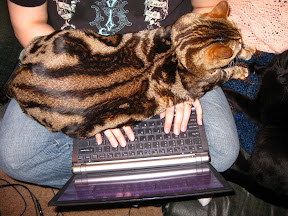
Start your blurb with your main character. Tell me what they want. Then tell me why they can’t have it.  This is important because what a character wants conveys a ton of behind-the-scenes info about who they are. My cat Teisel wants to win fights and feel like he’s better than everyone. I could tell you that Teisel is furry and has both stripes and spots, but that’s not what’s important about him, and it doesn’t tell you anything about his personality or why you should care about his struggles. And if after telling you he wants to win fights and feel like he’s better than everyone I add that he’s lost every single fight he’s ever started because he’s too worried about winning to actually act, now we don’t just have a character, but the makings of a story. It poses the unasked question of “What happens next?”

It’s easy to fall into the trap here of actually telling us what happens next and just listing events. For the most part, you want to forget about events. And you certainly don’t want your blurb to read like a laundry list of plot points. I could say Teisel gets in a big fight. He loses the fight. He feels even worse about it. You might notice how boring those sentences are, even though they’re about a fight, but the real problem with them is that they don’t give us a reason to care about it. Again, what makes us care are characters and conflict. For example, a conflict-focused version of the previous list of events might start out like this: Teisel challenges his worst enemy, Kitten the Undefeated, to one final fight to see who is permanently crowned king of the cat tree. Technically, there is an event here–a fight over a cat tree. But that’s not what’s important about it. What’s important is that Teisel is challenging his worst enemy (and this tells us a lot about him as a character, because even though he’s too afraid to act in a fight, he’s still bold enough to make this sort of challenge), who we see is undefeated (meaning Teisel, who has a 100% losing streak, has no chance of winning), and we see that there are consequences to losing this fight (the loss of the cat tree, which is also a high up place where Teisel can look down on others and feel important; losing both the big fight and his claim to the tree will mean he has no way to achieve his goals).

Pile on your conflicts, showing us the obstacles your character has to face to achieve their goal. Give them impossible odds to overcome, and make sure we know what will happen if they fail. Piling up the odds is no good if we don’t know the consequences, and the consequences are only as good as how badly they screw things up for our characters.

You don’t need to tell the whole story in the query letter. It’s okay to leave out or fudge things that are too complicated to get across in the two or three paragraphs you have for your blurb. And it’s okay to leave off the ending. My favorite way to end a story blurb is to leave the character with an ultimatum, one that could go either way and that leaves the audience wanting to know which choice they’ll make. This is easiest to do by giving them two equally important goals and a reason why they can’t have both.

So, to sum it up:

  1. Give us a character. Tell us what they want, why they can’t have it, and what will happen if they don’t get it. While doing this you’re sneakily showing us who they are and what their world is like.
  2. Focus on the conflicts and opposing forces your character has to deal with rather than events. Keep ’em coming until achieving their goal seems impossible, but make sure we know why they absolutely have to succeed. Whatever will happen if they fail will be worse than facing all those impossible odds.
  3. Throw in a complication that makes the character have to choose between two things that are important to them. They can’t save their childhood sweetheart and the kids in the orphanage across town where they grew up–they have to pick one, but both are important to them, and both are choices they could actually make. Leave us there, desperate to know which one they’ll choose.


You can read the story blurbs I’ve written for my books on my site, www.chelseamcampbell.com, under Books. The blurb for The Rise of Renegade X is what I used in my actual query letter, and what my publisher ended up putting on Amazon. But I also wanted to give an example not based on a real book, to show that it doesn’t really matter what the story’s about, so I leave you with this:

Winning the world figure skating championship is boy’s only chance of winning a college scholarship and getting out of a lifetime of working at his family’s bean farm as soon as he hits eighteen. But when his girlfriend and figure skating partner breaks his heart by selling her skates to buy a guitar and go on a cross country road trip without him, boy scrambles to find someone else in his one horse hometown who can take her place, at least on the ice if not in his heart.

Just when boy thinks he’s found the right girl for the job – his goth girl neighbor who wouldn’t be caught dead in a frilly skating costume even if she didn’t hate him for pulling an embarrassing prank on her when they were kids – he sprains his ankle while attempting the super triple skate flip, the one move he’s sure could beat the odds and win him his scholarship. With the competition fast approaching, he’ll have to not only skate while injured, but pull off the most complicated move in the book.

Boy finally wins back goth girl’s trust, confessing that he only pranked her because he had a crush on her, and convinces her to skate with him. Romance kindles between them just as his ex-girlfriend whirls back into town with a new pair of skates in hand. She’s ready to take him back and do their old routine together, certain that, with his injured ankle, boy needs her skills now more than ever if he wants to win. Boy thought winning the competition and the scholarship was everything, but is it worth it if it means betraying goth girl, the only girl who’s ever stuck by him and might just be his one true love?


Instagram

Instagram has returned empty data. Please authorize your Instagram account in the plugin settings .

Please note

This is a widgetized sidebar area and you can place any widget here, as you would with the classic WordPress sidebar.