In Which Our Brave Heroine Becomes an Entrepreneur

I have meant to post a million times these last couple weeks, but it kept getting away from me.  Blog posts are always skittering away as soon as I turn on the light.  Or, in a less creepy metaphor, they’re like Lucy and the football.

Anyway, I relaunched my Etsy shop this past week and applied for my business license!  Applying  for a license was actually pretty easy–I just filled out a form and paid a small fee–but it felt pretty cool to declare myself a business.  Here’s a screenshot of my Etsy shop:

If you live in the NW, I got an artist’s table at GeekGirlCon, August 11th and 12th.  Come stop by and say hello!

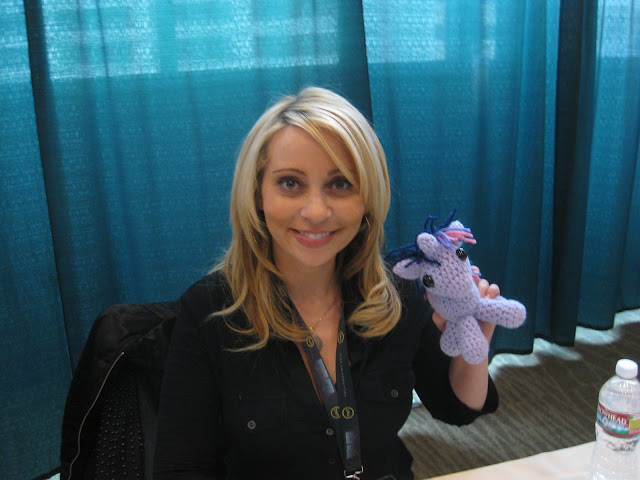
I also went to Comicon a few weeks ago, and it was amazing!  I hung out with author pal Karen Kincy and got to meet Tara Strong, the voice of Twilight Sparkle (and Batgirl in Batman: the Animated Series, Timmy in Fairly Oddparents, Rikku in FFX, Bubbles in Powerpuff Girls, Harley in Arkham Asylum and Arkham City, and she’s been in about a million other things, too).  She was so nice and great to see in person!  I gave her a stuffed Twilight Sparkle I made her and she was amazed and hugged it and let me take pics!

John DiMaggio, the voice of Bender on Futurama, was in the next booth over, leaving voicemails for fans from an angry Bender.  I got to go to the Futurama panel as well as the Batman panel, and everyone was amazing.  I’m definitely hoping to go again next year!

Plot, Dialogue, and Description – Oh My!

I said I had another post on writing coming up, and here it is!

So, last time, Julia asked:

Do you think you could do a post on sentence-by-sentence spice-adding, in terms of dialogue and such? The problem I often have with writing is that my plot either moves too quickly and I can’t think of what to put for actual descriptive meat, or I get bogged down in descriptions and dialogue and lose the plot there. Any tips?

I think the answer to both not having enough dialogue and description and of getting bogged down in it is remembering that every line of your story is an opportunity to strengthen characterization.  Plot itself can be extremely short and simple.  “A stranger comes to town” is an easy example.  This sentence implies potential conflict–who knows what kind of trouble a stranger coming to town might mean.  Depends on the town and the stranger.   You’re probably already picturing some kind of conflict, though, like a retired sheriff riding into a lawless Old West town in desperate need of someone to stand up against the bad guys.

I picked a sentence-long plot to show that a plot can be told in one sentence.  (All plots can be.)  Obviously when you’re working on your book, you’ll expand that plot and branch it out in more detail.  But the point here is that “plot” can be used up really fast, and if you’re relying on plot to make up the meat of your story, you might not get very far.  One way to think of it instead is to build the meat of your story on conflicts.

Let’s take our Old West sheriff for example.  What if the woman running the saloon is his childhood sweetheart, but they never got married and life took them in different directions, and now he’s a man of the law (or was, since he’s retired), and some of the goings-on in her saloon aren’t exactly on the right side of the law, but she’s happy to look the other way because she makes a good living off her less-than-savory customers.  She and the sheriff are still attracted to each other and longing for the past, but their current beliefs and situations are going to put a rift between them.  This is going to have an affect on every conversation and every description of the two of them.  A plot point could be that the retired sheriff witnesses a crime while in the saloon.  He could walk in, see the crime, and walk out, just like that.  But there’s a difference between describing an event and exploring conflict and characterization.  The ex-sheriff and the woman who owns the saloon are probably going to have some pretty interesting conversations, especially if they haven’t seen each other in years.  It might get even more interesting when he witnesses a crime take place, and he knows she knows about it, but that she also doesn’t care.  But he cares, even though he’s retired and has decided to stay that way and not get involved in keeping the peace here, even if it goes against his better nature.  So he’s not only struggling with the decisions she’s making, but with his own inner conflicts.  He can’t be with her and uphold the law.  And he can either be retired, which means letting things go, or he can step up and become the sheriff of this town, but he can’t have both.

That’s where your meat comes from.  Not from the event itself, but from the characters’ conflicting wants and their goals they can’t quite reach.  I think this approach would help with getting bogged down, too, because each line of dialogue and description are opportunities to add to our understanding of this situation.  It’s a chance to show us the characters’ opinions about each other and the world around them.  So every line that goes in will have a purpose, and that purpose is more than the sum of its parts.  A sentence describing the counter at the saloon needs to do more than just tell us what it looks like.  What it looks like needs to tie in to the characters, either by showing us their opinions of it, or showing how it fits into their lives.

The saloon was dark and dimly lit, a sharp contrast to the blazing sun outside.  He’d seen these types of places before, and this one was no different–shady and rotten to the core.  He’d heard it was hers,  that this was the kind of life she’d set up for herself after all this time.  Knowing she’d get involved with a no-good place like this, with gamblers and outlaws at every table, giving him hard looks, came as a shock.  She’d changed.  The girl he’d known wouldn’t have put up with these types, and not with the mud on the floor and the smoke clogging up the air either.  But as he sidled up to the bar, he noticed the counter.  Unlike everything else in this place, it was clean.  Spotless.  He smiled to himself, thinking maybe she hadn’t changed so much after all.

I could have just said he walked in and sat at the bar and noticed it was clean.  Or I could have gone on describing how everything looked until I lost track of why he’d come into the bar in the first place.  But what I wrote here tethers all the description to the characterization, whether it’s giving us a glimpse into the characters’ personalities, the conflicts between them, or both.

I’m back!

What? You didn’t know I was gone? Well, I was. My lack of posting this past week or so was due to me temporarily joining the 9 – 5 world. Or, technically, the 8 – 4:30 world. Now I’ve returned to the ranks of the gainfully happily self-employed.

This is going to be a brief post because I have a literature review assignment due on Saturday and I, er, haven’t picked a topic yet.  Hence, a bulleted list to create the appearance of being brief:

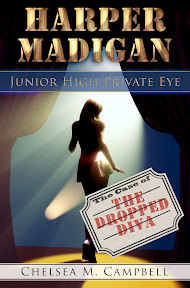
  • Harper Madigan: Junior High Private Eye is now out in paperback!  The paperback is gorgeous.  Here are some pictures to show you just how gorgeous.


For those of you holding out for a signed copy, you’ll be able to order one from me very soon.  Like, starting next week.

  • I heard from my cover artist for The Trials of Renegade X,  and the cover art is almost done!!!  If you want to see it before the general public, be sure to sign up for my newsletter so when everyone else sees it, you can be like, “Oh, that?  That is so last week.”  Except you’ll probably get to see it more like two weeks early, but saying, “That is so last fortnight,” doesn’t have the same ring to it.
  • I’ve got another post coming up on revisions and editing, this time focusing on the little stuff, as opposed to the big picture, so stay tuned for that.
  • And if you enjoy my posts on writing, you’ll be excited to know I’m working on my first ever non-fiction book (!!!!!), entitled BREAKING THE RULES: AN INTERMEDIATE GUIDE TO WRITING.  If you’re past the beginner stage but don’t yet have a book contract and want to amp up your writing, this book is for you.  And who doesn’t want to amp up their writing?  Especially for less than the price of a tall mocha frappuccino?

So there you have it.  These are all upcoming things for you to ponder while I desperately calmly finish up my literature review.

The Indie vs. the Traditional Debut

First things first, since you’re wondering, I put a progress bar for the Renegade X sequel up at the top of the site. My word count is so far embarrassingly small, but what I have is awesome, and I want to be more accountable for it. And I want you guys to get to see the progress I’m making. I have a tendency to take on too many things at once, and right now I’ve got too many jobs and am wearing too many hats, and not really getting anywhere. (Did you see that episode of Parks and Rec where Leslie was trying to juggle both her full time job and a full time campaign? Yeah, that was kind of a wake up call.) So anyway, it’s time to put some of those hats away and get focused on what’s really important.

And what you can’t see from the progress bar is that I’ve got a full synopsis, a bunch of notes, and detailed scene plans written up, so even though my word count is so far embarrassingly small, it’s only the tip of the iceberg. And, of course, there will be more words. Lots more words. I will attempt to update the bar at least once a day so you guys can follow along. And because I like getting to add to progress bars. ^__^

We now return to your regularly scheduled blog post…

So, I got to hold my new book for the first time yesterday. Check out the previous post for the video. It’s not the first time I’ve ever held my work in book form, but it’s the first time I’ve done it as an indie, and holding that proof copy of Harper Madigan was just as amazing as holding the ARC of Renegade X. For different reasons. With Renegade X, it was validation. It was “somebody deemed this story worthy and waved their magic wand and turned it into a real book!” With Harper Madigan, it was more “OMFG, I MADE this! And it’s here–it’s real!”

Traditional publishing can be slow. It’s a lot of rollercoaster. When you’re up, you’re way WAY up. Getting the call was probably the most exciting moment of my life. And getting to see my cover for the first time, and getting to hold my ARC… those moments were SO amazing. But there were months and months of nothing in between. Not that nothing was going on behind the scenes, but for the author… there’s a lot of waiting. And even though it’s an exciting process, it’s hard to maintain that level of energy for, say, the year or two or three that it takes for a book to actually come out. When Renegade X finally “debuted,” it felt more like the end of a journey, rather than the beginning of one. At least for me, as the author–for readers, of course, it’s different.

The indie process is different. With self-pubbing there’s been less of a crazy rollercoaster–at least so far–and no months long lulls of nothing. In fact, since I already had this book finished and pretty much ready to go, the whole process from deciding I wanted to publish it myself and holding it in my hands was only two or three months. And those were busy months of editing and finding the right stock image for the cover and laying out the interior for the print copy and coding the ebook. So when I held the book for the first time, the excitement was still fresh. This still feels like the beginning of this book’s journey for me, and I’ve been so involved with each part of the process that it feels very hands-on and made getting to hold the finished product that much cooler.

Is it more exciting than having Renegade X come out? Deciding to self-publish was not more exciting than getting The Call, but releasing the book as an indie has been much more exciting than the final, official “release day” for my traditionally pubbed book. Up until I decided to self-publish the Renegade X sequel a few months ago, I never saw myself self-publishing. And I certainly didn’t expect it to be so fulfilling or to be so exciting or to come with such a sense of accomplishment. I thought, “When I hold my book, it will be ho hum, because it’s not ‘real.'” But then it was here, and it’s VERY real, and it turned out holding it was just as amazing as getting my first ARC. And I never expected that.

Post Birthday/Book Birthday Post!

My 30th birthday turned out to be excellent.  I can’t believe I’m starting a new decade of my life!  Anyway, it was a great birthday, despite the two hour inconclusive doctor visit from hell.  (They decided I don’t have asthma, but don’t know what might actually be wrong.  Um… yay?)

On the bright side, I got to go out to dinner afterwards, which is one of my favorite things to do.  There was much nomming of noms and it was good and we had a little lava cake at the end, which is the best kind of cake.  And later I got a surprise visit from some friends who took me out for milkshakes, and a great time was had by all!

And I released my book, like a kraken!  *pictures it swimming furiously through the ocean towards unsuspecting pirate ships*  My first indie venture, and I am quite pleased.  The cover turned out amazing, the ebook is very nicely coded (if I do say so myself), and people are buying it.  And saying good things:

This book has got a lot going for it. Is this a hard boiled detective novel, or a teen adventure story? You decide. For me, the juxtaposition of the two is what makes it shine. If you liked Nancy Drew or the Hardy Boys, you’ll enjoy Harper Madigan, not because it’s similar, but because it’s so different.

Reminiscent of Buffy or Angel, the story bounces between serious and funny without giving the reader a minute to catch his breath. It’s not “belly-laugh” funny, but more, “cool as a cucumber” funny.

That review really captures what I love about this book!  Sometimes that’s so hard to put into words, even when you’re the author.  And any day when my work gets compared to Buffy or Angel is a good day in my book.

The paperback version is almost ready.  My proof copy is on its way, though it might not get here until the 12th.  I am spoiled from Amazon Prime, and I thought since Createspace is an Amazon company that it would carry over, but no…  But it’s shipped and will be here soon.  Hopefully everything will be sparkly and wonderful and error-free and I’ll be able to approve the book for publication.

You will be able to get signed copies directly from me once it’s out, too.  I’ll post more details about that when it releases.

Win Free Stuff!

Harper Madigan: Junior High Private Eye is out today!  *happy dance*  Harper Madigan is a noir detective story set in junior high.  See below for a more detailed description.

To celebrate, I’m giving away 10 free ebook copies (winner gets the format of their choice), and one grand prize of an ebook copy and a signed paperback once it’s available later this month!  The contest starts now and runs through Sunday, March 4th.  I’ll announce the winners here on the blog on Monday, so be sure to check back.

How do you win one of these marvelous ebooks?  It’s easy–I’ll be I’ll be tweeting the entry tweet from my account (@CampChelsea), and you can either RT me or copy and tweet the following message:


RT for a chance to win an ebook or print copy of #HarperMadigan: Junior High Private Eye! Full details at http://bit.ly/zK6HfA


Winners will be chosen randomly.  You can enter once each day on Friday, Saturday, and Sunday for a total of three entries.   And if you can’t wait and want to read NOW, you can sample and purchase the ebook at Amazon, Barnes and Noble,  Goodreads and Smashwords for $3.99.


7th grade detective Harper Madigan works alone.  He doesn’t need the vice principal assigning him a new partner to keep him in line, especially a stuffed-shirt wannabe-journalist who totally cramps his style.

And he especially doesn’t need his troublemaker ex-girlfriend showing up out the blue and asking for his help. She’s accused of attacking the star of the school musical, and with her less-than-sparkling track record, she’s only one suspension away from getting expelled.

Only Harper believes she’s innocent, and now it’s up to him to prove it, even if it means making an enemy of the PTA mafia, risking his agency, and confronting the mistakes of his own dark past. But when his new partner insists on doing everything by the book, and his old nemesis–the one bully he can’t catch–starts harassing his clients, it’s going to take more than just detective work to solve the case.


From Swamp to Zing – Chelsea’s Guide to Revising

I’ve been meaning to write this post for over a week and for various reasons haven’t gotten to it. But I’m here now, so let’s talk revision!

On an earlier post, Maya pointed out:

What I realized a lot is that many websites talk about how to fix your story line by line, not really how to make it better as a whole such as choosing what to cut and what to add.

The straight up, annoying answer is that if something’s not moving the story forward, cut it.  And if there’s somewhere where the story could be moving more, add.  This is true, but it’s also the kind of answer that doesn’t really explain anything, and I hate those kinds of answers.  I like to know how things tick.

You might also notice that the two options I listed above are two sides of the same coin.  So basically every time you find something in your novel that isn’t moving things along or adding any oomph, whether it’s a sentence, a paragraph, a conversation, a scene, etc., you have the option to either cut it or add to it.  It’s like a sugar cookie.  You can either chuck that boring sucker or add frosting and sprinkles.

But before I get ahead of myself, let’s talk about what “moving the story forward” actually means.  For me, it means that your scene (I’ll use scene for sake of argument, but this applies on all levels of a manuscript) has more than one type of information going on.  A scene can further the plot (or subplot), deepen characterization, or enhance worldbuilding.  But what a scene needs to do is at least two out of the three.

This is also what a sentence needs to do as well.  This is what agents/editors/authors mean by “missed opportunities.”  Every line of your book is a chance to not just, say, describe what someone’s wearing, but to show what they’re wearing reveals about them (characterization), and it’s also a good opportunity to throw in some worldbuilding (what does what they’re wearing say about their world or their particular situation?), and possibly even plot (is that a bloody glove hanging out of her pocket?).  These things can also be achieved by giving us a character’s opinions about themselves and the world around them.

A scene as a whole can have these missed opportunities, too.  Maybe you have a scene you really love and all it is is your two favorite characters talking at the kitchen table.  And in all honesty it’s not really moving the story along, but you like it and you think it has potential.  And yeah, yeah, I know–kill your darlings.  Whatever.  But anyway, you argue that this scene has characterization.  This is where the main couple makes gooey love eyes at each other for twenty minutes.  But we already knew they were in love, plus… twenty minutes?  What is this scene really giving the audience?  Nothing.  It’s not deepening characterization if it’s not revealing anything new.

So what do you do to save this scene?  Change it up.  Add conflict.  Not necessarily between the two characters.  It can be an outside conflict.  But whatever it is should fulfill two of the requirements I listed.  Maybe while they’re talking at the table, having a normal boring conversation, but one of them is surreptitiously checking their phone every five minutes for a text that will call them away to their super secret spy job that the other person knows nothing about and that they probably won’t be coming back from this time.  It deepens characterization because now we’re watching how this person is handling the situation.  How do they talk to their loved one while knowing they might be permanently called away at any moment and the other person has no idea?  Do they get overly sappy?  Do they act super normal and don’t let on at all?  And what choice will they actually make once they get the text?  This also deepens plot because OMG, what is this spy mission?  Why is it so dangerous?  What is so important that they could even think about walking away from an ooey gooey love such as this?  It may even deepen worldbuilding, depending on what we already know and what’s going on, but it could be a great place to slip in some details.  An army of steam-powered robotic unicorns are heading towards the president’s dirigible and are going to shoot lasers at it and bring it down!

Now this scene is moving things along.  And you could easily take it further and add in more issues that make the choice for our gooey spy lover even harder.  You could up the ante on the plot and say if our spy doesn’t go on this mission, their love is going to die, and now it’s not much of a choice for them (though how they handle it still is), and they have to break their lover’s heart to save their life.

And okay, you might be thinking, “That’s great if I have a scene I want to save, but I still don’t know what to cut!”  An easy list of things to cut is anything you feel “has” to be in the book, but that is ultimately boring.  Like, say, a character walking to their friend’s house.  Or a wandering group of minstrels traveling across the countryside to get to the castle.  You may catch yourself going, “Ugh, I hate this… but it has to be here!”

Why?  Because the audience needs to see how the characters get from point A to point B?  A simple line stating “The minstrels spent months traveling all across the countryside, but now were finally here at the castle to play music for the king” (or whatever it is they’re doing there) works great.  Anything that is just there because “the audience” supposedly needs it is most likely filler.  It’s easy to fall into the habit of showing everything your characters do, but leave it out and save room for the good stuff.  And don’t force yourself to write something boring because you feel it “needs” to be there.  You have my permission to skip that scene and write what you really want to write about.  You will be happier, your characters will be more interesting, and you’ll have a better chance of drawing your audience into your story.

If you get stuck, don’t agonize.  Just try something and see if it works.  If your equivalent of the dull kitchen table scene is someone walking from point A to point B and all the books say don’t show that, but you really like that scene and feel it’s important, but OMG, what will people think if you leave it in?!?!  Leave it in.  Spice it up if you need to.  But you might not even need extra spice.  If it’s meat and not filler, then it’s meat and not filler and there’s no reason to cut it.

Following these guidelines on all levels will strengthen your book and make it less swampy and more zingy.  And honestly, I could go on about revision for several more posts, so if there’s something I haven’t covered or you have questions, just ask!


Harper Madigan comes out this Friday!

A 7th grade noir detective. A femme – er, fille – fatale. A PTA mafia. Not your average mystery.

Harper Madigan: Junior High Private Eye comes out in ebook on March 2nd, which is this Friday, and also my birthday! (The paperback version will be out later this month, for anyone who’d rather have a physical copy. Or, you know, both–I won’t stop you.) The ebook is $3.99 and will be available for purchase through Amazon, Barnes and Noble, Goodreads, and Smashwords. I did not know you could buy books on Goodreads, but apparently you can!

To celebrate the release, I’m going to have a Twitter contest and am giving away 10 epub copies and 1 grand prize of an epub and a signed paperback, once it’s available. The contest will start on Friday and run through Sunday, and all you’ll have to do to enter is RT the contest tweet (which I will be posting here and tweeting on Friday). You can RT the contest tweet once per day to get extra entries (up to 3 total). Winners will be posted on the blog on Monday!

Stolen from Denise Jaden: What Do You Love About YOUR Writing?

Fellow Tenner and local author friend Denise Jaden made this post today about focusing on what we love about our writing, instead of picking at ourselves over what needs improvement.  As she says:

As writers, I think we spend a lot of time thinking about the areas we need to improve. And that’s necessary, it really is, but I don’t think we take enough time to balance out the scale and spend some focus on what we do well. Many a motivational speaker will tell you that what you focus on will be what flourishes in your life, and so it makes sense that if all we ever do is pick ourselves apart, our faults might just get worse instead of better.

I completely agree!  So today I’m making a list of what I love about my writing.  I can’t even remember the last time I made a list like this or really even thought about it.  And it’s important to think about it.  I think in our culture, and especially in the writing culture, berating yourself for never being good enough is the norm.  How can you be getting better if you’re patting yourself on the back?  I still remember in creative writing class (BARF) when the teacher said it was good that we were all making mistakes because that gave us so much to learn from. O__o  Honestly?  I don’t learn from mistakes nearly as well as I learn from someone who’s done something really well.  But that’s another post for another day, so onto what I love about my writing!

–I LOVE my voice.  Whichever character it is, even though they’re different from each other, they’re all still very me.  And, in a way, I get to be them for a while.

–I love reading my own writing.  I’ve known artists who could never stand their own work, whether it was visual art or writing or whatever, and while that might make them strive to get better, the thing is, it wasn’t a matter of being good enough or not.  And I know at least some of them gave up and stopped making art.  So I take the fact that I love reading my stuff as a good thing.  No matter what happens, I’ll always have at least one reader.

–I love my characters.  This ties into voice too, at least for the POV characters, but I love the others, too.  I love how over the top they can be, how realistic and down to earth, how funny or sad or angry.  I love that they’re all great people to spend time with.

–I love that I’m a fast writer.  And that I write better when I’m writing fast rather than slow.

–I love that I write about boys.  I don’t know why girl MCs fall flat for me when writing, but they do, and the boys take center stage.  Sometimes I wish I could write girl books, because maybe they’d be easier sells, but the truth is, I love writing about boys, and I love that I love it.

–I love that my books are quirky and campy.  I need the camp.  Without it, I am bored to tears.

–I love that I write great action scenes.  I dread writing them, which I think is part of why they end up working out so well.  Once I get to them, I just want to get them over with, which means they don’t drag on.

And… that’s probably enough love for now!  Go check out Denise’s post and tell her what you love about your writing!

Instagram

Instagram has returned empty data. Please authorize your Instagram account in the plugin settings .

Please note

This is a widgetized sidebar area and you can place any widget here, as you would with the classic WordPress sidebar.